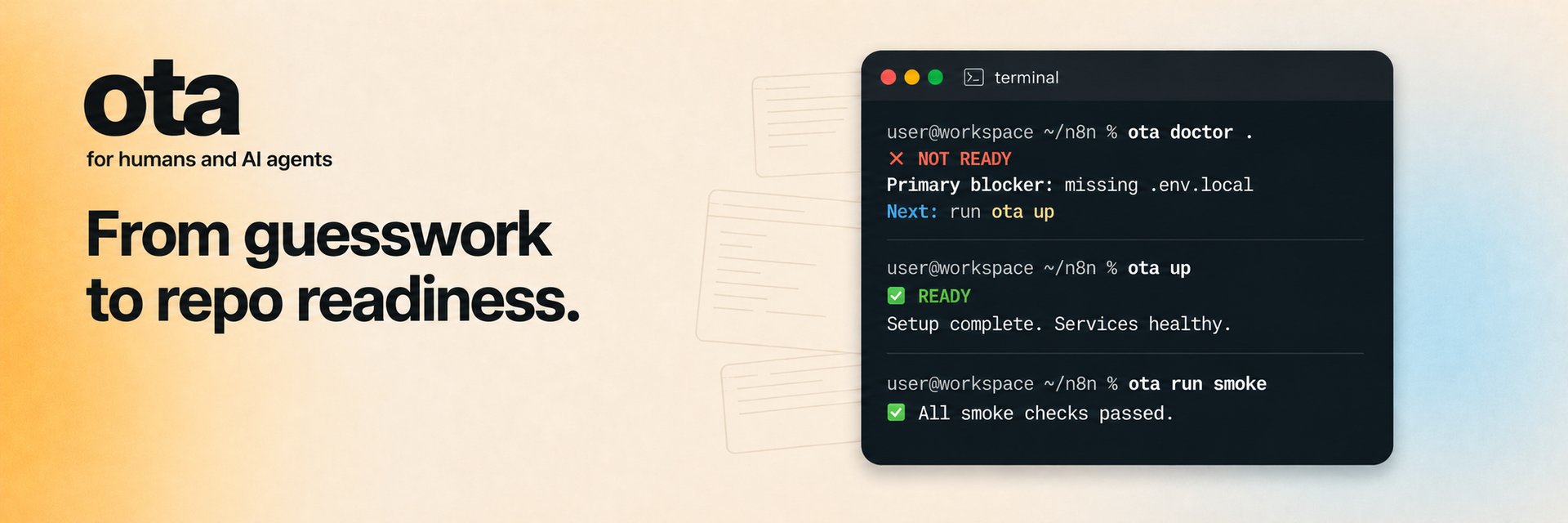
Ota is an open-source CLI for software governance.
It helps developers make the first successful run of a repository explicit, repeatable, and easier to trust across local development, CI, automation, and AI-assisted workflows.
Most repos look complete until you actually try to use them.
The real setup and runtime truth is often scattered across READMEs, scripts, CI config, environment files, Docker files, and tribal knowledge.
That makes onboarding slower, setup drift harder to catch, and automation more brittle.
Ota solves this through a readiness contract, defined in ota.yaml, that describes what a repo needs in order to be runnable and operationally ready.
From that contract:
developers can diagnose blockers with ota doctor
validate the contract with ota validate
prepare the repo with ota up
and run declared tasks with ota run <task>.
Key features include:
readiness contracts
blocker detection
next-safe-action guidance
task execution
workflow-aware setup
local/container/remote execution support
CI-friendly validation
machine-readable JSON output
execution receipts
and support for humans and AI agents working from the same repo truth.
The outcome is simple: less setup guesswork, fewer repeated onboarding issues, clearer CI signals, safer automation, and a repo that can explain what it needs instead of leaving every new developer or agent to reverse-engineer it from scratch.
Ota is built for developers, maintainers, teams, and AI-assisted development workflows dealing with unfamiliar, inconsistent, or operationally unclear codebases.