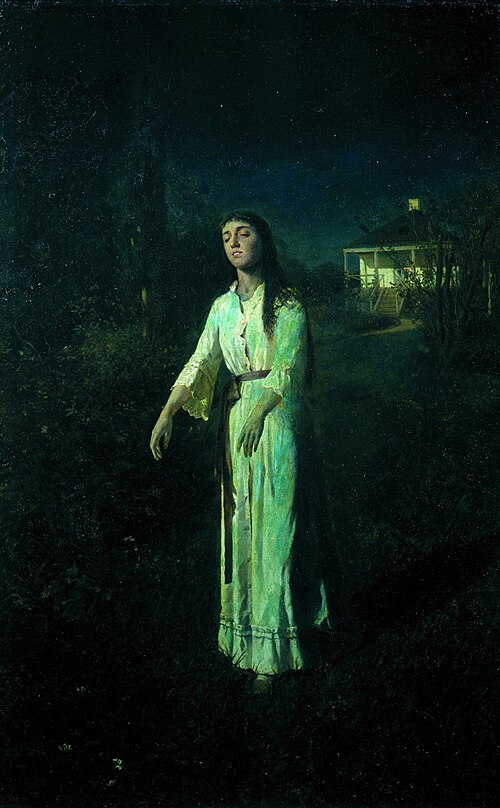
Sleepwalking, also known as somnambulism or noctambulism, is a phenomenon of combined sleep and wakefulness. It is classified as a sleep disorder belonging to the parasomnia family. It can also be understood as a disorder of state dissociation, which features of wakefulness and deep non-REM sleep occurring simultaneously in different brain regions. It occurs during the slow wave stage of sleep, in a state of low consciousness, with performance of activities that are usually performed during a state of full consciousness. These activities can be as benign as talking, sitting up in bed, walking to a bathroom, consuming food, and cleaning, or as hazardous as cooking, driving a motor vehicle, violent gestures and grabbing at hallucinated objects.
Although sleepwalking cases generally consist of simple, repeated behaviors, there are occasionally reports of people performing complex behaviors while asleep, although their legitimacy is often disputed. Sleepwalkers often have little or no memory of the incident, although some partial recall has been reported. Although their eyes are open, their expression is dim and glazed over. This may last from 30 seconds to 30 minutes.
Sleepwalking occurs during slow-wave sleep (N3) of non-rapid eye movement sleep (NREM sleep) cycles. It typically occurs within the first third of the night when slow-wave sleep is most prominent. Usually, it will occur once in a night, if at all.