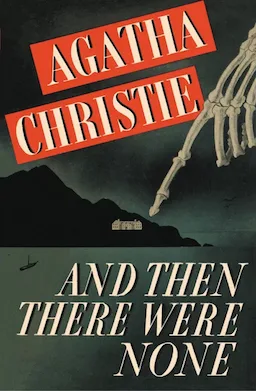
And Then There Were None is a mystery novel by the English writer Agatha Christie, described by her as the most difficult of her books to write. It was first published in the United Kingdom by the Collins Crime Club on 6 November 1939, as Ten Little Niggers, after the children's counting rhyme and minstrel song, which serves as a major element of the plot. A US edition was released in January 1940 with the title And Then There Were None, which is taken from the last five words of the song. All successive American reprints and adaptations use that title, except for the Pocket Books paperbacks published between 1964 and 1986, which appeared under the title Ten Little Indians. UK editions continued to use the original title until the current definitive title appeared with a reprint of the 1963 Fontana Paperback in 1985.
In 1990 Crime Writers' Association ranked And Then There Were None 19th in their The Top 100 Crime Novels of All Time list. In 1995 in a similar list Mystery Writers of America ranked the novel 10th. In September 2015, to mark her 125th birthday, And Then There Were None was named the "World's Favourite Christie" in a vote sponsored by the author's estate. In the "Binge!" article of Entertainment Weekly Issue #1343-44 (26 December 2014–3 January 2015), the writers picked And Then There Were None as an "EW favorite" on the list of the "Nine Great Christie Novels".
---
Also contained in:
- [Five Complete Novels of Murder and Detection](https://openlibrary.org/works/OL471812W)
- [Masterpieces of Murder](https://openlibrary.org/works/OL471974W)
- [Novels](https://openlibrary.org/works/OL24261345W)
- [Oeuvres complètes d'Agatha Christie: Volume VII](https://openlibrary.org/works/OL24710553W)
- [Works](https://openlibrary.org/works/OL17306242W)